

详细内容
Trusted Data for the AI Era
Observability, Quality, Governance, and Discovery in one control plane.
Built for engineers and business teams. Powered by AI agents.







SCALE DATA & AI PRODUCTS RESPONSIBLY
The Data & AI Control Plane
Siloed tools fragment information and erode trust. Our unified control plane is built on a context engine, bringing metadata, lineage, logs, validations, and health signals together to power every workflow and every AI agent with reliable data.


Pipelines scale faster than people
Thousands of data sets and infinite changes outgrow human capacity. You need AI to manage, monitor, validate, and triage data at scale, and reliable data is needed to power AI products.
AI for data reliability -> reliable data for AI
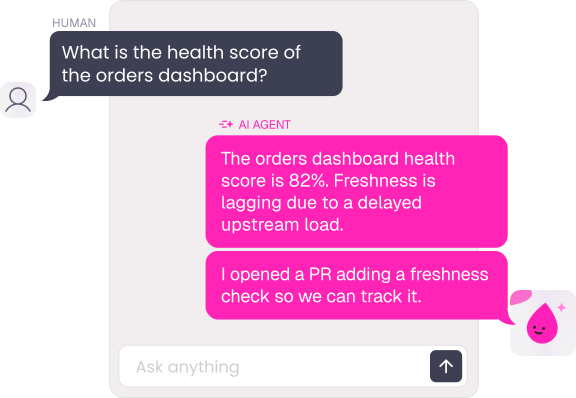
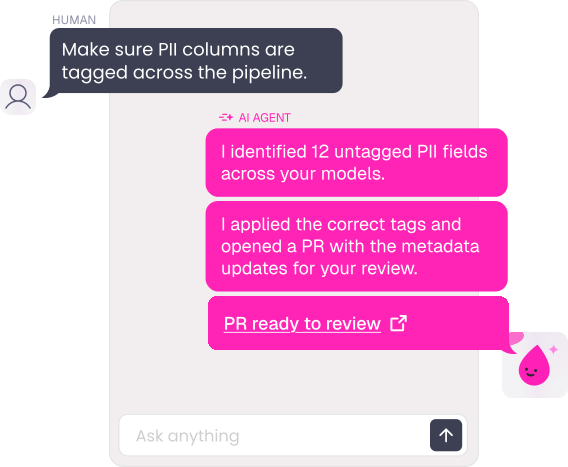
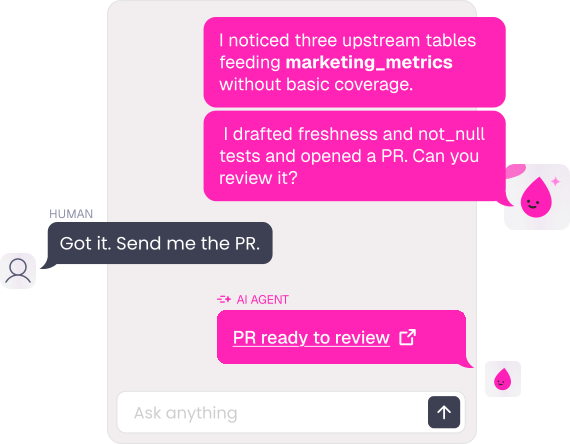
AI agents are the only way to keep up
Validate Data Quality
Triage and resolve issues
Enrich and Maintain Metadata
Analyze and Improve Test Coverage
Find and Understand the Data
Prevent breaking changes
Optimize Query Performance



Built for engineers, business users, and AI
FOR ENGINEERS
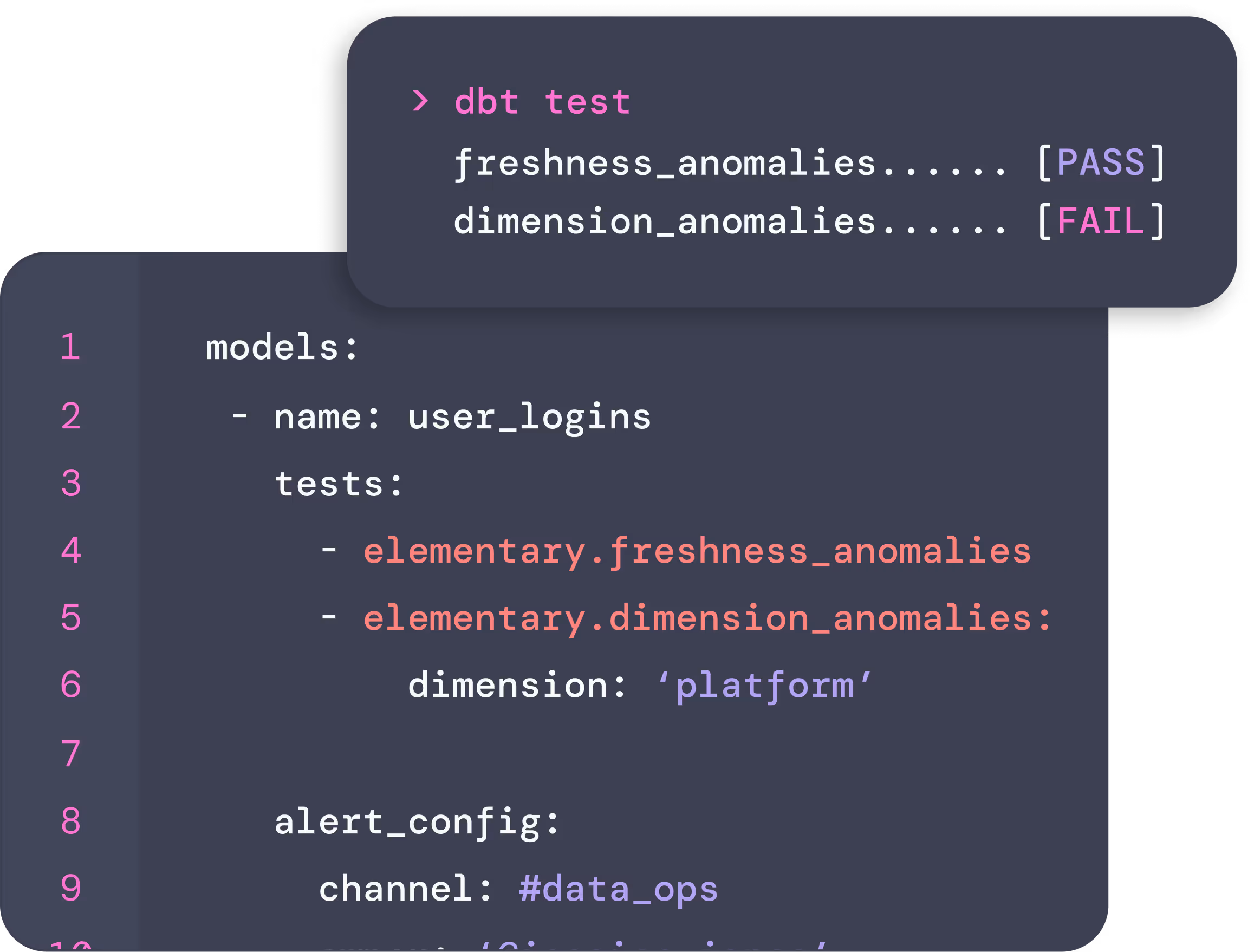
Code-first observability
Shift-left by managing tests, rules, and metadata in code. Observability should be managed like your pipeline: versioned, reviewed, and built with AI.

FOR BUSINESS USERS
AI-first data quality, discovery & governance
Users can get answers on data assets, how they are used, whether they are reliable, who owns them, and can safely contribute validations and documentation to the codebase.

Code as the source of truth
Bring tests, rules, and metadata into your codebase so you can prevent drifts and scale AI reliably.

dbt-Native by design
The Elementary dbt package seamlessly integrates your tests and artifacts with your data warehouse.

INTEGRATIONS
Any pipeline. Any data. End-to-end.
Ensure reliability across ingestion, transformation, semantic layers, BI, and AI through a shared context engine that collects and applies metadata, lineage, tests, performance signals, and usage patterns across your stack.
-
Integrates with every part of your data stack
-
AI agents and tools operate with shared context
-
Full lineage awareness across the entire pipeline
Teams doing data right
 \
\
“Thanks to Elementary, we only get alerts on real production failures. No alert fatigue, just real issues.”\
\
 \
\
Aviv Netel\
\
Data Engineering Team Lead\
\
Read Now →  \
\
"Each stakeholder can open the screen in the morning, get a quick overview of the data — and feel confident in its quality"\
\
 \
\
Shenhav Lavie\
\
Director of Data Engineering\
\
Read Now →  \
\
"With Elementary, we’re testing, tagging, and producing a ton of high-quality metadata — everything we need to establish that golden standard of trust."\
\
 \
\
Cory Woytasik\
\
Data Architecture / Governance Leader\
\
Read Now →
The tool your team will actually use
Incidents & alerts
Group related failures into clear, managed incidents and route context-aware alerts based on ownership and severity.
Automated pipeline monitoring
ML-based, out-of-the-box monitors that detect anomalies in freshness and volume before they reach downstream assets.
Data quality
Data quality checks that surface anomalies and inconsistencies, with built-in and custom tests built for both engineers and business users.
Column-level lineage
Understand your entire pipeline, from ingestion to BI, with column-level lineage that shows how each field is produced and what it impacts downstream.
Catalog
Ask about any asset and get definitions, ownership, tags, tests, usage, and health explained in a clear, conversational format.
Health scores
Get an overview of data health across domains, teams, and assets, with scores that measure all core data quality dimensions.
AI agents
Autonomous, context-aware agents that monitor your pipelines, recommend tests, enrich metadata, fix issues, and open PRs to keep your data & AI products reliable.
MCP Server
Expose Elementary’s context layer and agents through a standard MCP Server interface, making lineage, metadata, and data health available in any AI tool.
Performance & cost
Identify slow or expensive tests and models, understand their downstream impact, and surface optimizations that improve performance and reduce compute cost.





See Elementary in action


