详细内容

Events
Sign up
Sign up
FlowerA Friendly Federated AI Framework
A unified approach to federated learning, analytics, and evaluation. Federate any workload, any ML framework, and any programming language.
to learn federated learning

Users love Flower
❤️ Read more users' feedback →

“FL has always been a concept that has been daunting to me. It only took me 3 hours to understand it with Flower, using the great documentation and tutorials. ”
James Faure
Student Researcher at Stellenbosch University

“What is interesting about our partnership with Flower is it allows us to ship AI features that respect user privacy and that's why are continuing to partner with Flower on the next generation of Thunderbird ”
Ryan Sipes
Managing Director of Product at Mozilla Thunderbird

“In just a few lines of code I was able to federate my Machine Learning project.”
Sandra Carrasco
Deep Learning Researcher at AI Sweden

“Flower was much much easier to implement. We were wishing we had started with Flower to begin with! ”
Jason Mixon
PhD Student and Instructor at Dakota State University

“With Vana's focus on aggregating data into different data unions and Flower's expertise as the leading federated training framework you can train a model across all the different data DAOs.”
Anna Kazlauskas
Creator of Vana, CEO of Open Data Labs
Some of the best organizations in the world use Flower












Get Started
Build your first federated learning project in two steps. Use Flower with your favorite machine learning framework to easily federated existing projects.
PyTorch TensorFlow HuggingFace JAX Pandas fastai PyTorch-Lightning MXNet scikitlearn XGBoost
Select a tabTensorFlowPyTorchHuggingFaceNumPy
0. Install Flower
Copy
pip install flwr[simulation]
1. Create Flower app
Copy
flwr new # Select TensorFlow & follow instructions
2. Run Flower app
Copy
flwr run .
Flower in the Industry
Explore how Flower empowers AI across industries, driving innovation and collaboration.
 \
\
Automotive  \
\
Finance  \
\
Healthcare  \
\
IoT
Federated Learning Tutorials
This series of tutorials introduces the fundamentals of Federated Learning and how to implement it with Flower.
00

What is Federated Learning?
- Classic Machine Learning
- Challenges of Classical Machine Learning
- Federated Learning
- Federated Evaluation
- Federated Analytics
- Differential Privacy
01

Get started with Flower
- Preparation
- Step 01: Centralized Training with PyTorch
- Step 02: Federated Learning with Flower
02

Use a federated learning strategy
- Preparation
- Strategy customization
- Server-side parameter evaluation
- Sending/receiving arbitrary values to/from clients
- Scaling Federated Learning
Check out the rest of the tutorials:
Getting Started
Installation Guide
The Flower documentation has detailed instructions on what you need to install Flower and how you install it. Spoiler alert: you only need pip! Check out our installation guide.
PyTorch, TensorFlow, 🤗, ...?
Do you use PyTorch, TensorFlow, MLX, scikit-learn, or Hugging Face? Then simply follow our quickstart examples that help you to federate your existing ML projects.
PyTorch→ TensorFlow→ Hugging Face→ JAX→ Pandas→ fastai→ PyTorch-Lightning→ MLX→ scikit-learn→ XGBoost→
Why Flower?
A unified approach to federated learning, analytics, and evaluation.
Scalability
Flower was built to enable real-world systems with a large number of clients. Researchers used Flower to run workloads with tens of millions of clients.
ML Framework Agnostic
Flower is compatible with most existing and future machine learning frameworks. You love Keras? Great. You prefer PyTorch? Awesome. Raw NumPy, no automatic differentiation? You rock!
Cloud, Mobile, Edge & Beyond
Flower enables research on all kinds of servers and devices, including mobile. AWS, GCP, Azure, Android, iOS, Raspberry Pi, and Nvidia Jetson are all compatible with Flower.
Research to Production
Flower enables ideas to start as research projects and then gradually move towards production deployment with low engineering effort and proven infrastructure.
Platform Independent
Flower is interoperable with different operating systems and hardware platforms to work well in heterogeneous edge device environments.
Usability
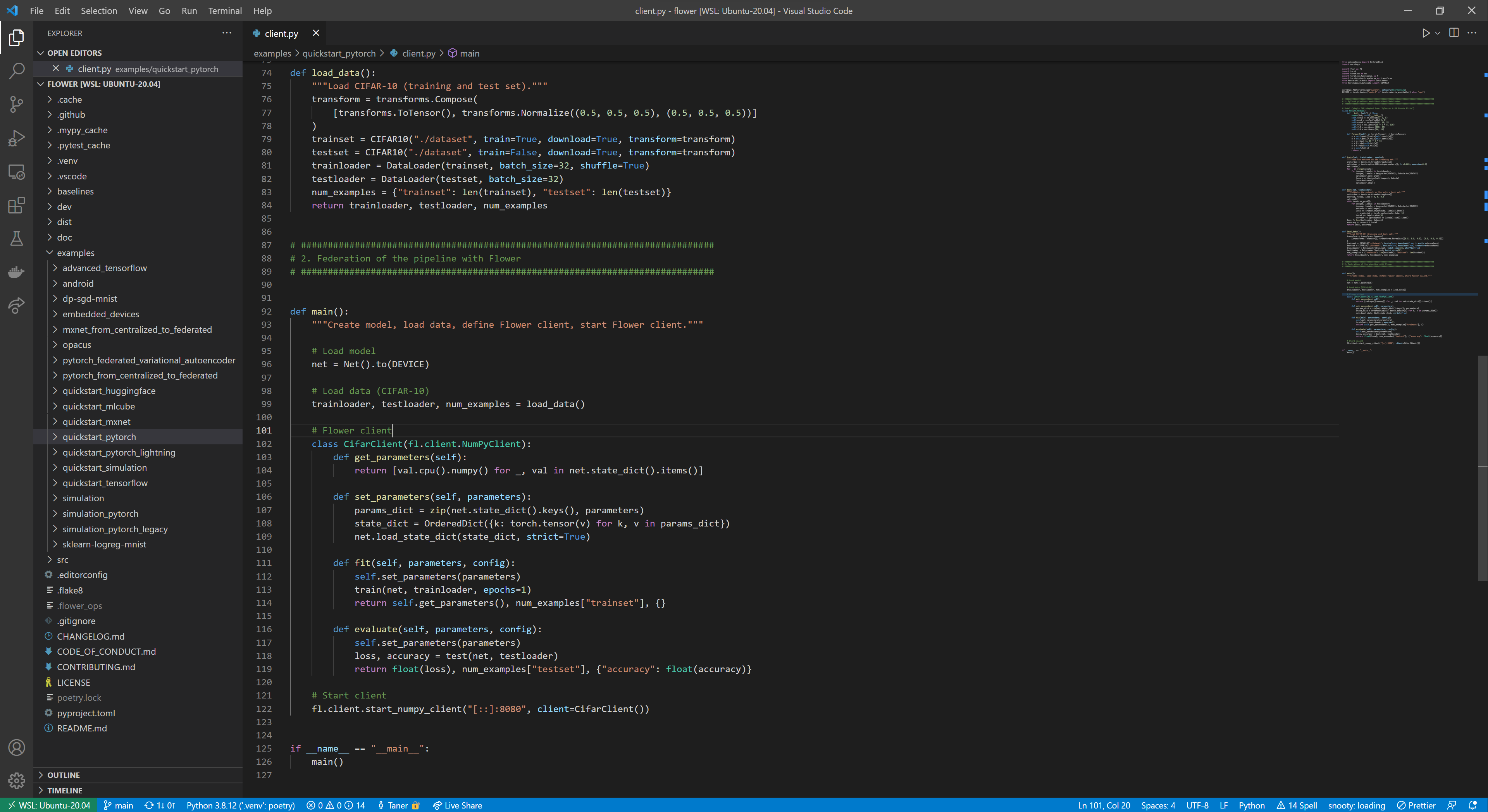
It's easy to get started. 20 lines of Python is enough to build a full federated learning system. Check the code examples to get started with your favorite framework.
Join theCommunity!
Join us on our journey to make federated approaches available to everyone.