

详细内容
AI Code Review. Deploy with confidence. Every time.
Qodo delivers context-aware AI code review for complex codebases. Standardize quality, detect real issues, and accelerate review time.
AGENTIC CODE SUGGESTIONS


Focused, accurate reviews
Qodo provides context-aware code suggestions that detect critical issues, logic gaps, enforce standards, and accelerate reviews with accurate, actionable insights.
LOCAL CODE REVIEW
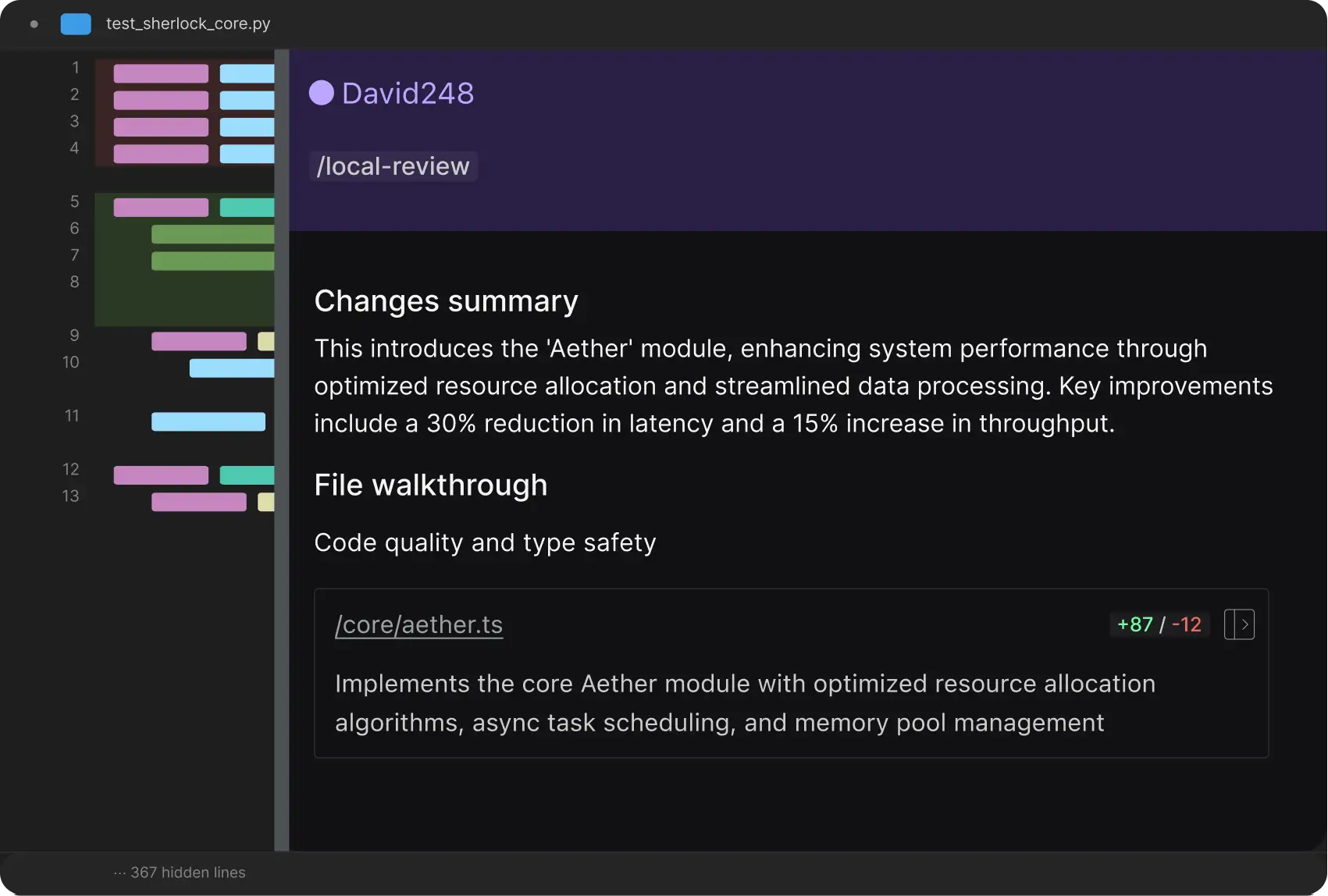

Real-time review while you code
Built-in review intelligence for your IDE with guided changes, precise code suggestions, and instant resolution.
COMPLIANCE CHECKS


Always compliant code
Validate pull requests against enterprise security policies, verifies ticket traceability, and enforces organization-specific compliance rules automatically.
ISSUE RESOLUTION


Resolve issues before commit
Fix issues at the source with precise, automated resolutions and verified code updates.


Use Qodo with any model.


Use Qodo with your tools, your workflows, and your AI models.


Cleaner code from the start
Shift-left reviews that detect bugs, missing tests, and logic issues as you code.

Smarter, faster pull requests
15+ agentic workflows that scale reviews to match AI development speed.

Consistent code quality
Continuous enforcement of coding, security, and compliance policies across the SDLC.


State of the art context engineering
Used by NVIDIA, Qodo’s context engine provides deep agentic code search and retrieval at enterprise scale


Multi-repository codebase understanding
Whether it’s 10 repos or 1000, instantly understand connections, dependencies, and impacts at any scale.

IDE
Git
 \
\
GENERAL \
2 min read\
\
\
Qodo Named a Visionary in the 2025 Gartner® Magic Quadrant™ for AI Code Assistants  \
\
TECHNOLOGY \
20 min read\
\
\
The Enterprise Guide for Code Quality Measurement Across the SDLC  \
\
GENERAL \
4 min read\
\
\
Cleaning Up Bugs in the Open-Source Community with Qodo: A Free Initiative in Collaboration with Google Cloud

Only necessary code analyzed

Data is SSL encrypted

SOC2 certification
What makes Qodo different from other AI code review tools?
Qodo is built for one job – code review at scale – while most AI tools treat it as a side feature of code generation.
Where others focus on writing more code, Qodo focuses on making sure the code you ship is correct, consistent, and compliant:
- Review-first, not copilot-first – Qodo acts as a dedicated AI code review layer, running across your IDE, pull requests, and CLI to continuously review changes, not just suggest snippets.
- Deep, multi-repo context – Qodo’s context engine understands entire codebases, dependencies, and patterns, allowing review agents to reason about impact across services and repos – not just a single file.
- Agentic quality workflows – 15+ specialized review agents automate tasks like bug detection, test coverage checks, documentation updates, and changelog maintenance, turning code review into a repeatable quality system.
- Standards and governance built in – Qodo enforces your coding standards, architecture rules, and compliance policies on every change, so large teams can keep code quality aligned as they scale AI usage.
In short: Qodo is where AI code review, code quality, and SDLC governance live together in one platform designed for teams that care as much about how code is reviewed as how fast it’s written.
Is Qodo suitable for large, multi-repo, multi-team engineering environments?
Yes, Qodo is specifically designed for large, complex engineering organizations:
- Multi-repo understanding – Qodo’s context engine can index dozens or thousands of repositories, mapping dependencies and shared modules so review agents can see cross-repo impacts.
- Team- and org-level policies – You can define standards once (security rules, architecture patterns, coding conventions) and apply them consistently across teams, services, and repos.
- Scalable workflows – Automated review flows run in IDEs and PRs without adding extra clicks for developers, so you can scale AI code review without overwhelming your teams.
- Mixed seniority support – Qodo helps junior and senior engineers converge on the same quality bar by embedding review best practices directly into the workflow.
If you have a lot of services, teams, or legacy + new code living together, Qodo is built for that reality.
How does Qodo help us clear our pull request backlog?
Qodo reduces PR backlog by pre-reviewing every pull request with AI agents, so human reviewers start with a prioritized list of issues, suggested fixes, and ready-to-merge changes.
Instead of reviewers opening a cold PR, Qodo does the groundwork:
- Automated pre-checks on every PR Qodo’s review agents scan each pull request for bugs, logic gaps, missing tests, risky changes, and security issues, then summarize the most important findings.
- High-signal, suggested fixes Workflows like
/compliance,/improve,/analyze, and/implementturn many findings into concrete suggestions or code changes, so reviewers can approve or tweak instead of starting from scratch. - Fewer bad PRs reaching reviewers The same agents run earlier in the IDE, catching issues before they ever become PRs. That means fewer noisy or low-quality pull requests in the queue.
- Clearer, auto-documented PRs Commands like
/describeand/add_docsautomatically generate PR descriptions and documentation, making it faster and safer for maintainers to understand and merge changes.
Taken together, this turns PR review from a manual slog into a review-ready queue, so teams can work through backlogs faster without lowering the quality bar.
What is the ROI or efficiency gain we can expect from using Qodo?
Qodo delivers ROI by shortening review cycles, cutting manual review work, and reducing issues that slip into production. In one deployment with a Global Fortune 100 retailer, Qodo saved over 450,000 developer hours in a year, with developers saving around 50 hours per month each. That kind of gain lets teams reinvest time into shipping features faster, improving architecture, and raising the overall bar for code quality. Read the case study here.
Can Qodo enforce our organization’s coding standards and compliance rules?
Yes. Qodo can turn your coding standards, architecture guidelines, and compliance rules into checks that run automatically on every change.
- Configurable rulesets– Encode rules for style, patterns, frameworks, security, and compliance (for example, required libraries or disallowed APIs).
- Automated enforcement– Review agents check each diff in the IDE and PR against these rules and flag or block non-compliant changes.
- Actionable fixes– Qodo suggests concrete code changes to bring a diff back in line with your standards.
- Centralized governance – Standards can be managed centrally and applied across teams and repos, making it easier to keep large organizations aligned.
Continuous learning – Qodo’s feedback improves with each code suggestion you accept, and it learns from past PR history, comments and discussion to continuously adapt to your coding standards.